
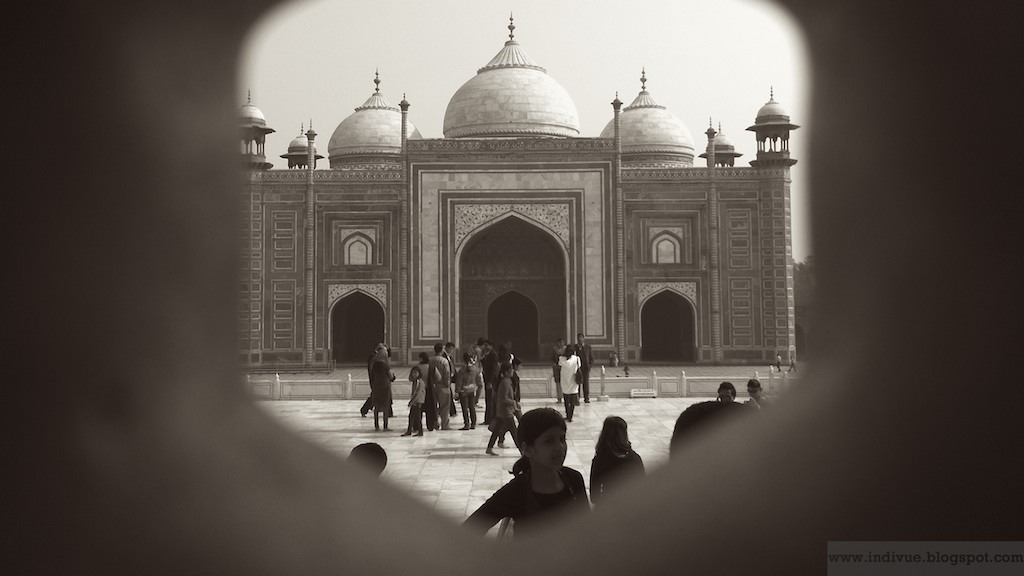
Entering the inner sanctum of the Taj Mahal, you find yourself drawn into a space that exudes tranquility, reverence and profound beauty. The experience of being inside this monumental structure, next to the graves of Emperor Shah Jahan and his beloved wife Mumtaz Mahal, while still able to see outside, is a uniquely stirring experience.
Architectural Grandeur and Artistic Mastery
The walls of the Taj Mahal are a masterful blend of elegance and simplicity. The marble walls are adorned with intricate floral designs, calligraphy and inlays of precious stones. The craftsmanship is so delicate and refined that the surface appears almost translucent, reflecting a soft, ethereal glow.
At the center of the inner chamber inside Taj Mahal lie the cenotaphs of Shah Jahan and Mumtaz Mahal, exquisitely crafted in marble. It’s important to note that these are false tombs, but still the cenotaphs offer a tangible connection to the love story that inspired the monument.
A Connection Between the Inner and Outer Worlds
One of the most striking aspects of being inside the Taj Mahal is the interplay between the inner space and the world outside. Delicate lattice screens, known as “jalis,” allow diffused light to filter into the chamber. These screens, made from marble and carved with incredible precision, provide glimpses of the gardens and connect the interior with the natural surroundings.
This connection adds to the contemplative ambiance of the inner chamber. The soft light and the distant call of birds all contribute to a sensory experience that is both intimate and expansive.
Symbolism and Spiritual Resonance
The Taj Mahal’s interior is imbued with symbolism that resonates on various levels. The floral motifs represent the paradise of Islamic belief, while the recurring number eight in the architectural design symbolizes infinity.
Being next to the graves, one cannot help but reflect on themes of love, mortality, and transcendence. The Taj Mahal stands as a testament to love that defies death, a love so profound that it inspired one of the most magnificent architectural wonders of the world.
The Final Resting Places of Shah Jahan and Mumtaz Mahal
The story of Shah Jahan and Mumtaz Mahal is one of history’s most famous love tales. It is a story that has transcended time, and their final resting place, within the Taj Mahal, has become a symbol of their undying love.
Historical Context
Mumtaz Mahal, the favorite wife of Mughal Emperor Shah Jahan, died during childbirth in 1631 in Burhanpur, where she was temporarily buried. Her body remained there for six months. Devastated by her loss, Shah Jahan commissioned the Taj Mahal as a mausoleum to honor her memory. It took 22 years and the collective efforts of over 20,000 workers to complete this architectural marvel. Her body was exhumed from the temporary burial site in Burhanpur and transported to Agra, where it was reinterred in the Taj Mahal.
After Shah Jahan’s death in 1666, his body was laid to rest next to Mumtaz Mahal’s, in accordance with his wishes. Their final resting place within the Taj Mahal is a poignant testament to their profound connection.
Architectural Significance
The graves of Shah Jahan and Mumtaz Mahal are located in a crypt beneath the main inner chamber of the Taj Mahal. Unlike the ornately decorated cenotaphs that are visible to visitors, the actual graves are relatively simple.
I have not personally seen, but it is said that the crypt is a quiet and somber space, and the graves are modest, following Islamic principles that emphasize humility in death. Mumtaz Mahal’s grave is centered, with Shah Jahan’s beside her, a configuration that is an unusual deviation from the strict symmetry observed elsewhere in the Taj Mahal.
The burial site of Shah Jahan and Mumtaz Mahal has become a powerful symbol of love and devotion. The Taj Mahal is often seen as Shah Jahan’s love letter to Mumtaz Mahal, and their side-by-side burial symbolizes their eternal union.
Emotions and Reflections
For many visitors, being inside the Taj Mahal is an emotional experience. There’s a quiet reverence that pervades the space, a sense of being in the presence of something timeless and sacred. The artistry, the connection to nature, and the story behind the monument all come together to inspire deep reflection.
Being next to the graves, amid the delicate beauty of the inner chamber, while still connected to the world outside, is to be immersed in a space that transcends time and place. It invites contemplation on love, life, and the human ability to create beauty that endures. In a world often preoccupied with the superficial and transient, the Taj Mahal’s interior stands as a sanctuary, a place where one can reconnect with what is eternal and true. It is a love poem etched in stone, a tangible manifestation of the intangible, and a gentle reminder of the profound connections that bind us to each other and to the world around us.
Useful links:
- Video of Taj Mahal in one minute
- Visual travel guide INDIVUE – Trip to India
- INDIVUE – Trip to Bollywood



 INDIVUE - travel & art
Leave a comment