
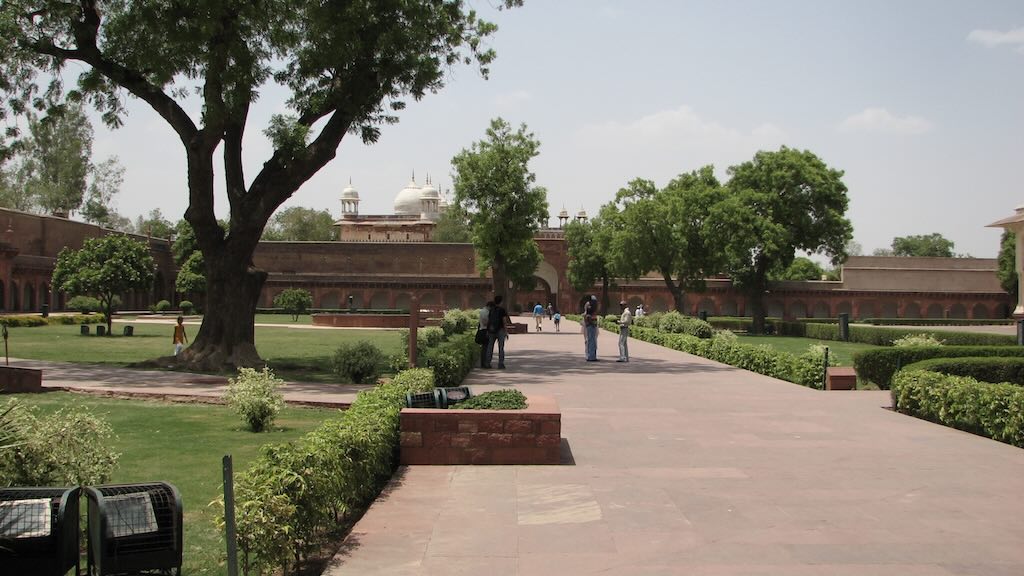
Red Fort in Agra, also known as Agra Fort, is one of India’s most important historical monuments. It is located in the city of Agra in the state of Uttar Pradesh, just a few kilometers away — and within direct line of sight — of the world-famous Taj Mahal. The fort is a UNESCO World Heritage Site and a prime example of Mughal military and palatial architecture. Watch the accompanying video I filmed inside Agra Fort, as well as a short video from 2007 showing the exterior of the fortress.
Agra Fort – The Powerful Fortress of the Mughal Empire
Agra Fort was built mainly in the mid-16th century during the reign of Emperor Akbar. An earlier brick fort had stood on the same site, but Akbar ordered it to be replaced with a massive complex constructed from red sandstone. Building work began in 1565 and continued for several years. Later emperors, especially Jahangir and Shah Jahan, expanded and embellished the fort with marble palaces and elegant courtyards.
Structurally, Agra Fort has a semi-circular layout and is surrounded by walls rising up to 20 meters in height. Inside the fort lies an entire imperial city, complete with palaces, mosques, audience halls, and gardens. Among the most important structures are the Diwan-i-Am, the Hall of Public Audience, and the Diwan-i-Khas, where the emperor received selected guests. The complex also includes Jahangir’s Palace, the Khas Mahal, and the Musamman Burj tower.
The historical significance of Agra Fort is closely tied to the power politics of the Mughal Empire. It served as the main residence and administrative center for several emperors before Delhi rose as the imperial capital. One of the most famous episodes associated with the fort is the fate of Shah Jahan: he was imprisoned here by his own son Aurangzeb and spent the final years of his life in Musamman Burj, gazing at the Taj Mahal, which he had commissioned in memory of his beloved wife Mumtaz Mahal.
Architecturally, Agra Fort represents the evolution of Mughal design from a purely military stronghold into a luxurious palace complex. The red sandstone gives the fort its distinctive color and name, while the extensive use of white marble during Shah Jahan’s reign added lightness and refined ornamentation. Geometric patterns, floral motifs, pietra dura inlay work, and water features reflect Mughal aesthetics and strong Persian influences.
Today, Agra Fort is one of India’s most visited attractions and a key stop on most Golden Triangle itineraries connecting Delhi, Agra, and Jaipur. Visitors can walk through the fort’s monumental gates, courtyards, and palaces while enjoying views of the Yamuna River and the Taj Mahal. The fort offers a profound insight into the daily life, governance, and architectural legacy of the Mughal rulers.
Agra Fort is both a historic fortress and a living monument to India’s past. It tells a story of power, family relations, religion, and art during a period when the Mughal Empire was among the most influential in the world. With its massive walls and refined palaces, Agra Fort remains one of India’s most fascinating and multi-layered historical sites.
Learn more about travel in Agra and India from my Visual Travel Guide to India.
Hotel from where you can see Taj Mahal



 INDIVUE - travel & art
Leave a comment