
Barcelona is like an open-air museum when it comes to sculpture, because every square, street, and promenade seems to be holding pieces of art. Statues and sculpted façades reveal the city’s history, maritime spirit, religion, literature, and modern creativity. This guide highlights 5 remarkable works that reflect Barcelona’s cultural soul. Barcelona’s statues are decorative art and also storytellers of the city’s layered identity. From poets and saints to sculptures of human connection, each piece adds depth to the city’s character. Looking up at these works it reveals Barcelona for travelers a true gallery under the open sky.

Joan Salvat-Papasseit statue in Barcelona – A Tribute to a Catalan poet
Barcelona’s waterfront offers more than sea views and palm-lined promenades. As you stroll along the Passeig de Colom, close to the historic Port Vell, you will come across a striking bronze statue dedicated to Joan Salvat-Papasseit (1894–1924), one of Catalonia’s most beloved poets.
Salvat-Papasseit’s life was short but intense. Born in Barcelona, he grew up in modest circumstances and developed an early interest in literature and social issues. He became known as a passionate avant-garde writer, influenced by modernism, futurism, and the social movements of his time. His poetry often reflects revolutionary ideals, youthful energy, and the maritime spirit of Barcelona, the city that shaped his worldview. Despite his early death at just 30 years old, he left behind a body of work that continues to inspire Catalan literature.
The statue captures Salvat-Papasseit in a bold and powerful pose, almost as if stepping forward from a block of stone. The figure’s strength mirrors his uncompromising voice and the cultural awakening that he represented. Surrounded by palm trees and framed by the grand architecture of the old port buildings, the monument creates a symbolic connection between Barcelona’s maritime heritage and its literary tradition.
Visiting the statue is not only an encounter with art but also with history. It reminds passersby of a time when Barcelona was redefining its cultural identity, and poets like Salvat-Papasseit gave voice to modern ideas. For travelers exploring the area, it is a worthwhile stop that adds depth to a walk along the city’s seafront.
If you’re heading towards Port Vell, La Rambla, or Barceloneta Beach, the Joan Salvat-Papasseit statue makes for an interesting landmark along the way. It is also a great photography spot, offering views that combine the monument, the palm trees, and the backdrop of the city’s historic port.

Barcelona’s Customs building and its sculpture group
Walking along Barcelona’s seafront promenade towards Port Vell, it’s hard to miss the impressive building crowned by a striking group of statues. This is the Edifici de la Duana del Port – the Port Customs House, completed in 1902.
The building is a fine example of eclectic and neoclassical architecture, adorned with ornate details, lion figures, and the Spanish coat of arms. At the very top, the sculpture group symbolizes commerce, navigation, and Barcelona’s role as a thriving Mediterranean port city. The central figure represents Spain or Catalonia in allegorical form, while the flanking figures embody trade and industry.
The Customs House is located on Passeig de Colom, right by the waterfront and the lively Port Vell marina. It is a popular spot for visitors to pause and admire the architecture that bridges the city and the sea.
Both the building and its sculptures serve as a reminder of the era when Barcelona rose to prominence as a hub of maritime trade.
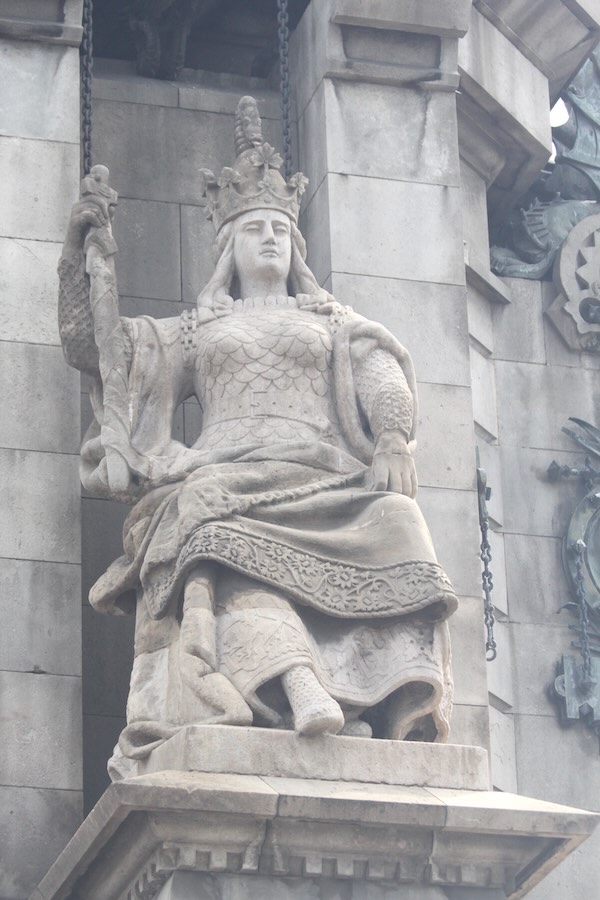
The Columbus Monument – Kingdoms of Spain at the Base
One of Barcelona’s most iconic landmarks is the Columbus Monument (Monumento a Colón), located at the lower end of La Rambla, near Port Vell. Built for the 1888 Universal Exposition, it quickly became a symbol of the city, with Christopher Columbus himself standing at the top, pointing towards the sea.
What often goes unnoticed is the richly decorated base of the monument. It is surrounded by impressive stone figures representing the historic kingdoms of Spain, such as Castile, Aragon, León, and Catalonia. Each is depicted as a seated monarch, wearing royal attire and a crown, holding symbols of power.
The statue in the photo is an allegory of the Kingdom of Castile, one of the most important realms in Spanish history. Together with the other figures, it symbolizes the union of kingdoms that enabled Columbus’s voyages and the discovery of the New World.
By walking around the Columbus Monument base and looking closely, one discovers the detailed sculptures that tell the story of Spain’s past and its monarchical heritage.

The Barcelona Military Government building and its sculptures
On Barcelona’s seafront promenade, along Passeig de Colom, stands the imposing neoclassical Gobierno Militar de Barcelona – the Barcelona Military Government Building. Constructed in the early 20th century, it still serves as the headquarters of Spain’s Ministry of Defense.
The façade is crowned by monumental sculptures symbolizing military power and authority. A central figure rises proudly, flanked by allegorical statues in classical style. Together they create a majestic composition that makes the building one of the most distinctive landmarks along the seafront.
Although the building is not open to the public, its architecture and sculptures can be admired from the street. The Military Government Building remains a reminder of Barcelona’s strategic importance as both a Mediterranean port and a city with a long military history.

Pareja – The Couple sculpture in Barcelona
Along Barcelona’s waterfront promenade, on Passeig de Colom, visitors will find a striking bronze sculpture titled “Pareja” (Couple). The work was created by Catalan sculptor Lluís Cera (born 1967), known for his modernist style and textured, expressive surfaces.
This sculpture depicts a male and a female figure as torsos, sitting side by side yet distinct. Its rough texture and fragmented form highlight both the vulnerability and strength of the human condition. The piece evokes reflections on relationships, connection, and individuality.
Pareja is one of the many public artworks enriching the seafront area of Barcelona. For travelers, it offers a contemplative pause amidst palm trees and sea breezes, combining art with the city’s maritime atmosphere. In Finnish language the word pareja means couples. So the same thing as in Spanish, but in plural.
Read more about travel and art in Spain and Europe from my Visual travel guide to Europe and subscribe my blog to get the new updates to your email!
Read and watch also

 INDIVUE - travel & art
Leave a comment