

A few years ago, I shared on my blog a video about a charming seaside café located in Munkkiniemi, Helsinki. At that time, however, I didn’t mention the area’s architecture, even though right there, along the tram tracks, stands a building that makes you stop and admire it.
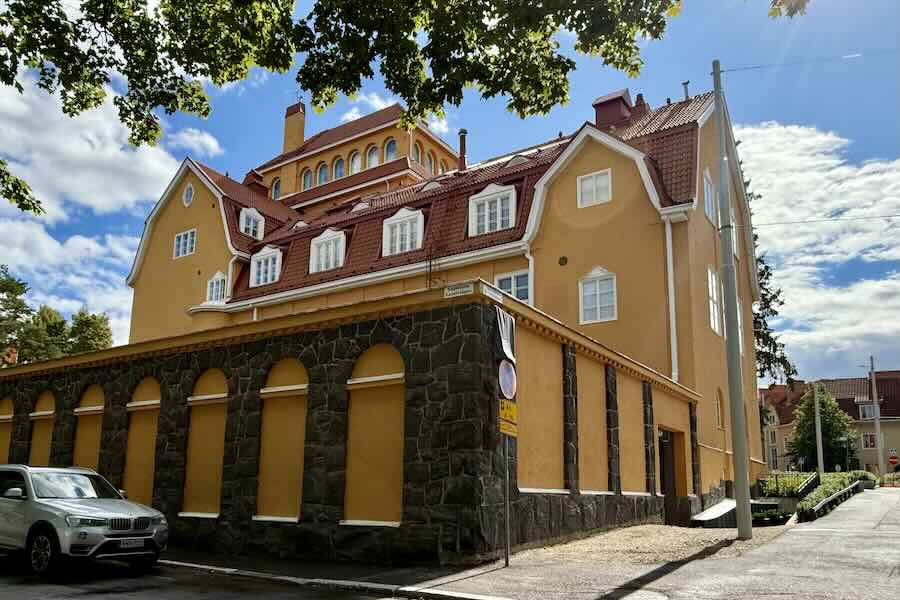
It is a large house glowing in orange, designed by Eliel Saarinen. It’s the kind of architecture that pleases the eye – and makes Helsinki’s concrete suburbs from the 1960s and 70s pale completely in comparison to this Munkkiniemi beauty.
The hand of Helsinki Central Railway Station’s architect
The designer, Eliel Saarinen, is best known for Helsinki Central Railway Station. In this Munkkiniemi building, you can also see similar features: clarity, rhythm, and a dignified, timeless architecture. Originally, the building was planned as a hotel, but its purpose has changed over the years. It has, among other things, housed activities of the Finnish Defence Forces, and today it is home to privately owned apartments.
A visit inside a Saarinen-designed home
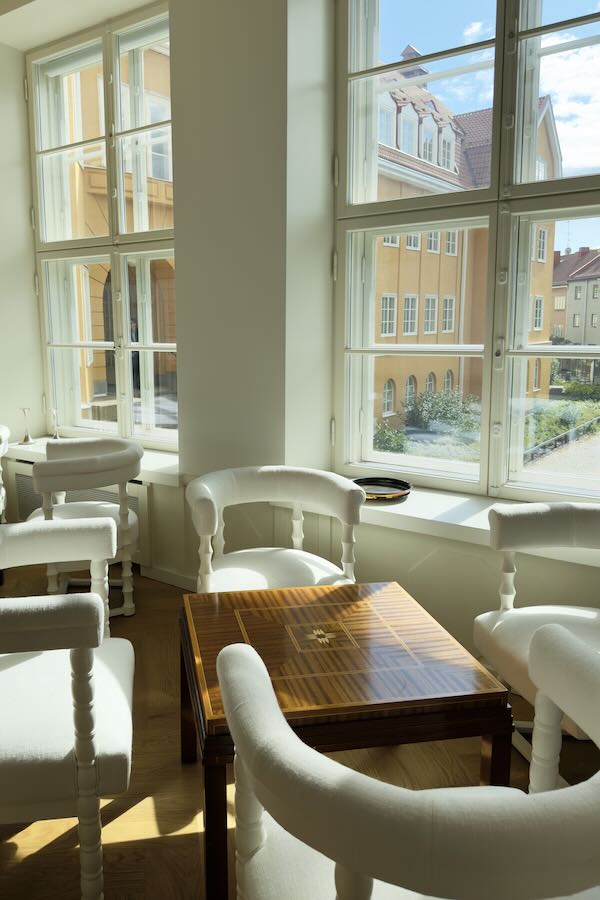
I had the opportunity to step inside one of these apartments during a book launch event. The experience was striking: the interior contained furniture designed by Eliel Saarinen, beautiful lamps, and other design classics. The stylish and carefully thought-out interiors reminded me how much our surroundings influence everyday comfort and overall well-being.
Memories of old stone houses in Kallio
Looking around the apartment, I was reminded of my own past: I once lived in Helsinki’s Kallio district in an old stone building with deep window niches – the same kind of atmosphere found in Saarinen’s Munkkiniemi creation.
But alongside the beauty, I also remember the challenges. That Kallio apartment was freezing cold in the winter and unbearably hot in the summer. In winter, I had to bring in an extra heater just to get through the season, while in summer the place turned into an oven as the sun blazed through the windows all day long. Cross-ventilation wasn’t possible, and leaving the front door open to the stairwell was out of the question.
How livable are Saarinen’s homes?
As I explored the Munkkiniemi apartment, I couldn’t help but wonder: what are Saarinen’s homes like to actually live in? At least in this case, cross-ventilation worked perfectly – a small but important detail that makes daily life more comfortable.
A new book on Saarinen homes
Fittingly, the publisher Rakennustieto recently released a book titled Eliel and Eero Saarinen Homes. Written by Jari Jetsonen and Sirkkaliisa Jetsonen, the book presents homes designed by both Eliel and his son, Eero Saarinen. The release date was August 20th – which happens to be the birthday of both father and son.
The book can be ordered from Rakennustieto’s online store, and it offers an inspiring look into two generations of Saarinens designed homes that continue to resonate and fascinate even today.
Who Was Eliel Saarinen?
Eliel Saarinen was born in the parish of Rantasalmi, Finland, in 1873 and rose at an early age to the international forefront of architecture.
He became well-known together with Herman Gesellius and Armas Lindgren. Their three-way collaboration culminated in the Finnish Pavilion at the Paris World Fair in 1900, where Finnish Jugend architecture received international recognition.
Helsinki’s Most Iconic Buildings
Helsinki is full of Eliel Saarinen’s work, and the Helsinki Central Railway Station is his most famous creation. Completed in the 1910s, it remains today one of the most beautiful railway stations in Europe. Its massive granite walls, symmetry, and the iconic stone figures have etched themselves into the memory of countless Finns as well as international visitors.
Another significant building is the National Museum of Finland, designed by Saarinen together with Lindgren and Gesellius. The tower and the rough granite façade evoke the power of medieval castles and create a striking silhouette in the cityscape of Helsinki.
And as the Munkkiniemi example shows, Saarinen did not restrict himself to public buildings alone, but also designed residential quarters and town plans. His vision for the Munkkiniemi–Haaga area was an ambitious project for its time, partly realized, and it laid the foundation for Helsinki’s expansion westward.
Other Works in Finland
Beyond Helsinki, Saarinen left his mark on several Finnish cities:
- Lahti City Hall (1911–1912) represents his late Jugend period.
- Joensuu City Hall (1914) is the cultural heart of the city and one of its most beloved buildings.
- Hvitträsk in Kirkkonummi, the trio’s own studio home, is today an essential part of Finnish cultural history and a pilgrimage site for architecture enthusiasts.
Career in the United States
Saarinen moved to the United States in the 1920s after his success in the Chicago Tribune skyscraper competition. Although his stepped tower design was never built, it influenced the form language of many American skyscrapers.
In America, his most significant achievement was the Cranbrook Educational Community in Michigan, where he created a learning environment in which architecture and art intertwine. Together with his son, Eero Saarinen, he also designed Kleinhans Music Hall in Buffalo and the modernist First Christian Church in Columbus, Indiana.
Eliel Saarinen’s Legacy
Eliel Saarinen passed away in 1950, but his work continues to live on. In Finland, he helped define the architectural identity of a young nation through monuments like the National Museum and the Railway Station. In the United States, his vision shaped the development of modernism and laid the groundwork for the next generation of architects – not least his son, Eero Saarinen.
When one looks at the orange building Saarinen designed in Munkkiniemi, one sees a small piece of the same mastery that made him internationally renowned. His buildings are not just walls and roofs – they are stories of time, people, and culture.
This article is part of my
→ Trip to Helsinki – Visual Travel Guide.
You can find all my Helsinki travel videos
→ here.

 INDIVUE - travel & art
Leave a comment