
-

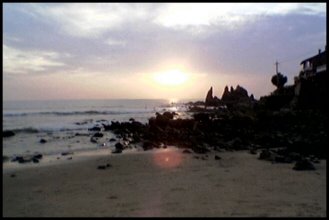
 Last Thursday began the international filmfestival, IFFI, in Goa’s capital Panjim. I couldn’t make it there to the opening, but from the Candolim beachside I admired those three fighterplane’s show in the sky. Each one them drew a different colour, and the show ended in a Bollywood way, when those two fighter planes drew a big heart in the sky, and then disappeared.Wellknown local artist Subhod Kerkar is having his big fineart exhibition right in the middle of sunbathers, dogs and cows on the Candolim beach, and the exhibition is called Sea & See.Last week some strange heatwave hit Goa and the weather was truly burning hot and overhumid. The heat didn’t ease off even for the night. After this, the air stopped, and during daytime there was no wind blow, not even on the beach. The sea was almost still. Then came couple of cloudy days, and to me clouds are almost a miracle here in the Goan sky. Now the weather seems to be cooling down. Luckily.December is soon at hand, meaning that the prizes of accommodation will rise up. I’ve been looking for a long-term accommodation for a good prize, but so far I haven’t found a place that I’d like enough.December and new year are almost fully booked everywhere, also in my present guesthouse, so I hope I won’t be left without a rooftop over my head…
Seriously speaking, I shouldn’t need to worry. I went to see one nice house in Anjuna, close to the sea. But the decision is dependant on several things. The following days will tell.Those bombblasts in Delhi, few days before my coming to India, and the possible threat of terrorism in Goa may have reduced the amount of tourists here. This is what the locals say. And at least during the weekend there wasn’t much people nor happening on the beach, which is exceptional. Otherwise you don’t see or experience this threat of terrorism here.
In a party in Finland, couple of days before my coming here, J recommended me to visit the Tree in Goa. So yesterday I decided to drive through Anjuna, Vagator, Chapora and Mandrem to Arambol. And to my surprise I saw Finnish Pelle Miljoona jogging there on the beach.
The path to the Tree was surprisingly long, and pretty hard to walk. At some point I even began to regret my going there. But the nature was beautiful, green, and there were lots of banyontrees and monkies were jumping on their branches. My clothes were wet from sweat when I finally reached the Tree.
There, in the middle of the jungle, under a huge banyon tree lived a woman, and there with her were also her friend and her puppy and some older local man, an altar, guitars and lots of exotic birds singing in the middle of otherwise quiet nature.
In the middle of that camp was a fireplace, and I suppose people have a habit of gathering around it to smoke some drugs. Now wasn’t it under a boddhi tree where Buddha was enlightened as well? This might be their point with this Tree.. I decided to skip that experience. Still my way back was lighter, thanks to endorphins.
Update in 2023: About the Tree in Arambol
The Arambol Banyan Tree is a renowned and spiritually significant landmark in the beach town of Arambol, located in the northern part of Goa, India. The tree is a mature banyan, which is a type of fig tree known for its vast, spreading canopy and complex root system. Banyan trees hold immense cultural and religious importance in India, often being associated with spirituality and enlightenment.
The Arambol Banyan Tree is situated near a freshwater lake and the Paliem Sweet Water Lake, which are themselves popular destinations in Arambol. The area around the tree is often considered a hub for alternative lifestyles, attracting a range of visitors including yogis, spiritual seekers, and artists from around the world. Some people believe the tree has a particular energy or aura, and it is not uncommon to see individuals meditating or practicing yoga in its vicinity.
In addition to its spiritual allure, the tree is visually striking and provides a rich subject for photography. Its sprawling branches and complex root system create an intricate natural architecture that invites contemplation. The shade it provides makes it a gathering spot, where both locals and tourists often convene for relaxation or conversation.
Although the tree is a subject of admiration and wonder, it is important to treat it—and the surrounding area—with respect. Many people consider the tree sacred, and local customs and beliefs should be acknowledged when visiting. Overall, the Arambol Banyan Tree stands as a testament to the enduring connection between nature and spirituality, drawing visitors into a unique experience that transcends mere sightseeing.
Read more about traveling in Goa from my visual travel guide INDIVUE – Trip to Goa
-

 Last night it finally did happen.
I was on my way to a beach shack for a dinner, walking in the dark, when suddenly I realized the sand under my sandals felt odd..I looked behind me, and saw a big pile of cow dung on which I had just stepped..
Locals were there to advice me what to do. That is to rub the sandal in the sand and knock it on something hard. And so shall the dung fly.The good thing in this accident was that – when you step on a cow dung accidentally, it will bring you good luck.. according to an old Indian belief. This is what they told me.What else happening here – Well, I live in a wonderful place, in a homey guesthouse, so close to the sea that one can listen to the waves when in the balcony, and see them as well, if one really wants to.Food is heavenly good most often. In Helsinki / Finland you go to an Indian restaurant and pay 20 euros for mere thali. But here you can get a thali with less than a euro, and a special thali with one and a half euros. So you wont be starving. At least not, if you’re a Westerner.Whereas mosquitos, they are hungry here. Every evening at least one of them bites me.The other night was a full moon night. And the other day I visited a Finnish friend of mine, who spends her winters in Goa. She had a lovely appartment. It was wonderful to be in Anjuna again.Update in 2023: Facts about cow dung
The belief that stepping on cow dung brings good luck is rooted in Hinduism and the broader cultural context of India, where the cow is often regarded as a sacred animal. According to Hindu mythology, the cow is a symbol of non-violence, and it embodies virtues like gentleness and generosity. Many Hindus, not all, believe that cows are the abode of 33 crore (330 million) gods and goddesses. In this context, cow dung is also considered pure and auspicious.
In traditional Indian homes, particularly in rural areas, a layer of cow dung is often spread on the floors and walls. This practice is not only believed to bring prosperity and good health but also has practical applications: the antiseptic properties of cow dung are thought to purify the living space. In agricultural communities, cow dung is widely used as a natural fertilizer and is considered vital for crop growth, adding another layer of importance to this substance.
Additionally, the act of stepping on cow dung is thought to have a grounding effect, connecting the individual to the Earth and, by extension, to life’s natural cycles. This could be interpreted as inviting good luck by promoting a state of spiritual and material balance.
It should be noted that while this belief is prevalent among certain sections of Indian society, it’s not universally accepted. Modern, urbanized populations in India may not adhere to this belief, and there are diverse views and practices within the country’s various regions and communities.
So, the notion that stepping on cow dung brings good luck is a complex interweaving of religious belief, cultural tradition and practical utility.
Read more about travel in India
Watch my video of cows in Goa, India
Cows in Goa, India Press the play button and see also cows in Gokarn
Cows in Gokarn, India