• "Stepping on cow dung brings a good luck"

    Last night it finally did happen.
    I was on my way to a beach shack for a dinner, walking in the dark, when suddenly I realized the sand under my sandals felt odd..
    I looked behind me, and saw a big pile of cow dung on which I had just stepped..
    Locals were there to advice me what to do. That is to rub the sandal in the sand and knock it on something hard. And so shall the dung fly.
    The good thing in this accident was that – when you step on a cow dung accidentally, it will bring you good luck.. according to an old Indian belief. This is what they told me.
    What else happening here – Well, I live in a wonderful place, in a homey guesthouse, so close to the sea that one can listen to the waves when in the balcony, and see them as well, if one really wants to.
    Food is heavenly good most often. In Helsinki / Finland you go to an Indian restaurant and pay 20 euros for mere thali. But here you can get a thali with less than a euro, and a special thali with one and a half euros. So you wont be starving. At least not, if you’re a Westerner.
    Whereas mosquitos, they are hungry here. Every evening at least one of them bites me.
    The other night was a full moon night. And the other day I visited a Finnish friend of mine, who spends her winters in Goa. She had a lovely appartment. It was wonderful to be in Anjuna again.

    Update in 2023: Facts about cow dung

    The belief that stepping on cow dung brings good luck is rooted in Hinduism and the broader cultural context of India, where the cow is often regarded as a sacred animal. According to Hindu mythology, the cow is a symbol of non-violence, and it embodies virtues like gentleness and generosity. Many Hindus, not all, believe that cows are the abode of 33 crore (330 million) gods and goddesses. In this context, cow dung is also considered pure and auspicious.

    In traditional Indian homes, particularly in rural areas, a layer of cow dung is often spread on the floors and walls. This practice is not only believed to bring prosperity and good health but also has practical applications: the antiseptic properties of cow dung are thought to purify the living space. In agricultural communities, cow dung is widely used as a natural fertilizer and is considered vital for crop growth, adding another layer of importance to this substance.

    Additionally, the act of stepping on cow dung is thought to have a grounding effect, connecting the individual to the Earth and, by extension, to life’s natural cycles. This could be interpreted as inviting good luck by promoting a state of spiritual and material balance.

    It should be noted that while this belief is prevalent among certain sections of Indian society, it’s not universally accepted. Modern, urbanized populations in India may not adhere to this belief, and there are diverse views and practices within the country’s various regions and communities.

    So, the notion that stepping on cow dung brings good luck is a complex interweaving of religious belief, cultural tradition and practical utility.

    Read more about travel in India

    Watch my video of cows in Goa, India

    Cows in Goa, India

    Press the play button and see also cows in Gokarn

    Cows in Gokarn, India
  • In Candolim, Goa

    In Candolim, Goa

    Candolim beach, Goa
    In the end the flight from Mumbai to Goa was over two hours late. Sun was setting when we finally got on board. I was admiring the beautiful sunset and taking pictures of it with my phone camera, when the airhostess started to complain and told me to delete all the pictures I had taken. I thought it was only in Goa airport, where you weren’t allowed to take photographs.
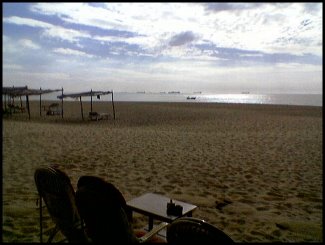
    Finally yesterday I got to wet my toes in the Arabian Sea. I enjoyed my tea in a beachshack, where I spent my time reading a good book until it was time for the sunset. Which was, beautiful.
    The only negative thing here in Goa, India, and I mean the only, is the hard mattress in my bed. Otherwise I’m happy.
    The weather is hot during daytime, but after a few days it will get cooler, say the locals. Nights are already rather cool – I’m almost freezing, when wearing a t-shirt only.
    Quite a many tourists have also arrived here. I was eating in a Chinese restaurant and the next table was having a conversation in Finnish.

    Update in 2023: Photographing in the airports

    Photography is often restricted in airports around the world, including Goa’s Dabolim Airport, for a variety of reasons primarily revolving around security and privacy concerns. Here are some of the key factors:

    1. Security: Airports are high-security zones. Unauthorized photography could potentially capture sensitive information that might be useful for those with malicious intent. This could include the layout of security installations, the locations of surveillance cameras, and even security protocols.
    2. Privacy: Airports serve a diverse range of people from different backgrounds and cultures. Photography might inadvertently capture people in the background, which could be a violation of personal privacy.
    3. Operational Efficiency: Airports are bustling places with many people moving about in a hurry. If everyone stops to take photos, it could disrupt the smooth flow of human traffic, thereby causing delays and potentially interfering with airport operations.
    4. Commercial Concerns: Some airports may have shops, lounges, or art installations that are proprietary. Unauthorized photography might infringe on the commercial rights of these establishments.
    5. Legal Liabilities: Photographs could be used in a way that is misleading or defamatory, creating potential legal issues for the airport authority.
    6. Distraction: Focusing on taking photos could distract individuals from paying attention to important announcements or instructions, particularly in emergency situations.
    7. Uniformity of Policy: Finally, having a clear and straightforward rule that applies to everyone helps in the easy administration and enforcement of these policies.

    Of course these rules may vary by location and specific airport regulations. Generally, if photography is crucial for a specific purpose such as journalism, one might need to get special permission from the airport authorities. Always check with local rules and regulations when traveling.

    Read more about traveling in India from my visual travel guide INDIVUE – Trip to India